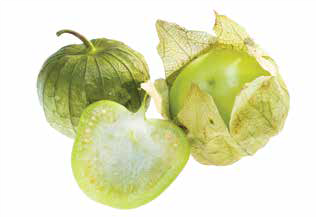
Tomatillos (Physalis ixocarpa) are relatives of tomatoes that are native to Mexico. They have leafy husks around the fruit and are much firmer than tomatoes with a tart flavor. There are also related species called husk tomatoes and ground cherries that are grown in similar ways, but have smaller, sweeter fruits. Most tomatillos will grow in Kansas, but the productivity can be variable. There are both green and purple fruited varieties, and fruit size ranges from 1 to 3 inches in diameter. Some varieties have a more upright growth habit, while others are more sprawling. Para información en español, visite este sitio web.
Plant tomatillos after all danger of frost is past in early to mid-May. Growth is poor when temperatures are below 60°F, so it is better to wait to plant until later if the spring is cool. Either purchase plants from a garden center or start seeds indoors 6 to 8 weeks before planting outdoors. Tomatillos are grown much like tomatoes and peppers. One significant difference is that tomatillos do not self-pollinate well, unlike tomatoes. Many types of tomatillos need two or more different varieties to set fruit, especially large amounts of good-quality fruit. If there is poor fruit set or unfilled husks, it is possible that a lack of pollination is the culprit.
Tomatillos are fairly bushy plants and should be planted 3 feet apart in the row. Allow 3 to 5 feet between the rows. Staking or caging is recommended to support the branches of upright varieties, which can be prone to breakage. Support is also recommended for the more sprawling types to help keep the fruit off the ground and improve harvest quality. Tomatillos will also root down when the stems touch the soil, so caging or staking can help prevent this.Each plant will yield 2-3 pounds of fruit. Plant 2 to 3 plants for fresh use, and additional plants for freezing and canning.
Sunlight:Tomatillos need 8 or more hours of full sunlight in order to be productive.
Watering:Water tomatillos deeply and infrequently, applying 1-2 inches of water per week. Mulch around the plants will help conserve soil moisture.
Soil and Fertilization:Avoid over-fertilizing tomatillos, as this can lead to excessive leaf growth, delayed fruit set, and delayed maturity. Side dress each plant with 1 tablespoon of (21-0-0) fertilizer, sprinkled around the plants at four and eight weeks after transplanting, then water in the fertilizer.
Transplanting:Plants can be started indoors, 6-8 weeks before the planting date. Transplant or seed directly in the garden after the danger of frost has passed.
Pests and Diseases:Poor fruit set due to excessive nitrogen and lack of cross-pollination can be a common issue.Spidermitesandaphids can also be pests of tomatillos.
Tomatillos are best harvested when fruits fill their husks but are still firm and bright green. Colored varieties often do not develop color until after the husk is split.Fruit become soft when overripe. For eating, pick mature fruit and store in the husk in a paper bag in the refrigerator for up to three weeks. Temperatures below 45°F can cause cold injury after a couple weeks of storage.At the end of the season, pull up the whole plant and hang upside down in an unheated garage or storage area. Fruit on the vines will store for several months. You can also pick fruits and store like green tomatoes. Fruits inside the husk are very sticky, so wash completely before eating or freezing.
Tomatillos can be preserved by freezing or canning. For more information on canning tomatillos and various recipes visit this site at the National Center for Home Food Preservation.
Tomatillos are an excellent source of vitamins C and K, iron, magnesium, phosphorus and copper. They are a very good source of dietary fiber and are rich in niacin, potassium, and manganese.
Tomatillo Green Salsa
Ingredients
Directions
5 cups chopped tomatillos
1-½ cups seeded, chopped long green chiles
1/2 cup seeded, finely chopped jalapeño peppers
4 cups chopped onions
1 cup bottled lemon or lime juice
6 cloves garlic, finely chopped
1 Tbs ground cumin (optional)
3 Tbs dried oregano leaves (optional)
1 Tbs canning or pickling salt
1 tsp black pepper
Combine all ingredients in a large saucepan and stir frequently over high heat until mixture begins to boil.
Reduce heat and simmer for 20 minutes, stirring occasionally.
Ladle hot salsa into hot pint jars, leaving ½ inch headspace.
Adjust lids and process in a boiling water canner: 15 minutes at 0–1,000 feet altitude; 20 minutes at 1,001–6,000 feet; and 25 minutes above 6,000 feet.
Combine the cilantro, tomatillos, garlic, avocado, jalapeno, onion, lime juice, cumin and salt in a food processor or blender and pulse until combined.
Set aside 1/2 cup of the guacamole for the creamy tomatillo dressing, and use remaining guacamole for another recipe.
For the charred corn salad:
Preheat a grill pan over high heat.
Brush or rub each ear of corn with the canola oil and sprinkle with salt and black pepper.
Grill the corn until it gets a nice char, 2 to 3 minutes per side. Set aside until cool enough to handle, about 5 minutes.
Stand each ear stalk-end down, in a wide, shallow bowl and slice the kernels off using your knife.
Combine the corn kernels, lime juice, avocado, Fresno chiles and red onions in a large bowl.
For the creamy tomatillo dressing:
Mix together the mayonnaise, 1/2 cup tomatillo guacamole, hot sauce, chili powder and cumin.
Add to the corn salad and toss to combine.
Fold in the cilantro and crumbled cotija and season with salt.
Serving suggestion: Portion the salad into small cups, squeeze additional lime over the top, and serve with a spoon.
 Tomatillos (Physalis ixocarpa) are relatives of tomatoes that are native to Mexico. They have leafy husks around the fruit and are much firmer than tomatoes with a tart flavor. There are also related species called husk tomatoes and ground cherries that are grown in similar ways, but have smaller, sweeter fruits. Most tomatillos will grow in Kansas, but the productivity can be variable. There are both green and purple fruited varieties, and fruit size ranges from 1 to 3 inches in diameter. Some varieties have a more upright growth habit, while others are more sprawling. Para información en español, visite este sitio web.