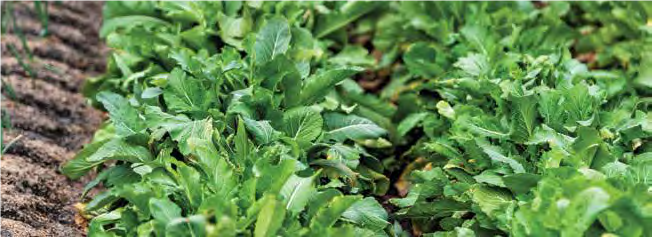
Mustard greens are a cool-season crop. They mature quickly and are easy to grow. Although cooking greens are popular in the South, many people recognize their high nutritional value, and greens are becoming more popular for use in light cooking and stir frying. Newer varieties of mustards have been developed for harvest as baby leaf salad greens rather than larger cooking greens. Most mustard varieties will perform well in Kansas if planted during the spring or fall. Look for varieties that are slow to bolt, especially when planting in the spring. Be sure to pay attention to whether a variety is intended for cooking or for fresh use, as many fresh use types do not grow larger leaves. A 10 foot row at recommended spacing will product 4 to 6 pounds of mustard greens. Para información en español, visite este sitio web.
Mustard is normally direct seeded in late March to early April or can be direct-seeded in early August for a fall crop. Fall is a preferred season for growing greens because of the long, cool, harvest season.
Mustard can be sown after soils reach 40°F. Seeds germinate best at 55-65°F and require 7-10 days to emerge. Seeds should be planted ½ inch deep and plants thinned to a plant every 2 to 4 inches. Rows may be as close as 15 inches apart, or you can plant mustard in a wide row by scattering seeds in a band 5 to 6 inches wide. Mustard that produces a large plant too early may bolt or produce a seed stalk with bright yellow flowers instead of producing only foliage. Once seed stalk development starts, leaves should be quickly harvested and used.
Sunlight:Provide at least 6 hours of direct sunlight during the day. If possible provide some shade during the hottest part of the day.
Temperature:As a cool-season crop, mustard prefers cooler temperatures and should not be planted in the heat of the summer. It will survive some light frosts in the spring and fall.
Watering:Mustard requires water during dry periods to keep the tender foliage from becoming limp. Provide an inch of moisture every week if not supplied by rainfall.
Fertilization:Apply ½ cup per 10 feet of row of a nitrogen-based fertilizer (21-0-0) 4 weeks after transplanting or thinning to encourage rapid plant growth. Place the fertilizer to the side of the plants and irrigate it into the soil.
Pests and Diseases:Like other leafy greens mustard doesn't compete well with weeds. Be sure to mulch around the mustard plants after they have germinated. Common insect issues includeaphids,cabbage worms,slugs, andflea beetles.
Cut the leaves when they are young and tender. You can cut the entire plant or individual leaves to allow the plant to continue to grow and produce more leaves. The young leaves, four to five inches long, are mild-flavored and can be eaten raw in salads. The older leaves taste better when prepared as cooked greens. Avoid yellow, over-mature mustards with seeds or yellow flowers attached. Leaves harvested in hot weather will be strong flavored and tough. Store leaves in a plastic bag in a refrigerator for 2 to 3 weeks.
Mustard is low in calories, fat, and cholesterol. Mustard is a very good source of dietary fiber, and contains large amounts of iron, beta carotene, and vitamin C.
Mustard Greens
Ingredients
Directions
25 to 30 leaves of mustard (a large handful)
4 to 6 pieces of smoked bacon, or another smoked meat
Salt
Wash greens twice.
Strip greens from midrib and tear or cut into small pieces. (You may cut stems into small pieces and cook separately. Stems will have the consistency of cooked celery.)
Put 4-6 pieces of smoked bacon or other smoked meat for seasoning into a six-quart pot.
Add one quart of water, bring to boil, and lower to medium heat for 30 minutes. Add salt to taste.
Add greens to water a few pieces at a time. As they wilt, stir and add more greens. Bring to a boil, then lower to a slow simmer.
Cover and cook until greens achieve the tenderness and flavor you desire. (About an hour if you want the greens to take on plenty of the bacon flavor.)
Drain, avoiding mashing the greens in the process, and serve.
Place the sesame seeds into a large skillet over medium heat, and cook and stir constantly until the seeds are toasted a golden brown and make a continuous crackling noise, 1 to 2 minutes. Transfer the seeds immediately to a bowl to stop the cooking process. Set seeds aside.
Place sesame oil in the hot skillet, and heat until it just begins to smoke (this should happen very fast).
Place mustard greens into the hot oil, and pour in water. With a spatula, gently toss the greens until they are wilted and reduced in quantity, about 2 minutes.
Mix in garlic, soy sauce, rice wine vinegar, sake, and sugar.
Bring the mixture to a boil, stir until sugar has dissolved, and cover the skillet.
Reduce heat to a simmer, and cook until the greens are tender, 10 to 15 minutes. If a thicker sauce is desired, remove greens with a slotted spoon, and cook the liquid down to desired thickness; return greens to the skillet, toss in the pan juices, and sprinkle with toasted sesame seeds.