Microgreens
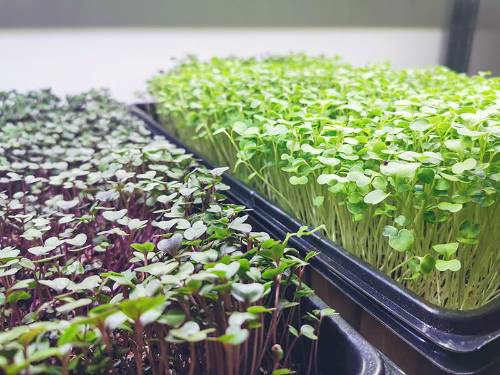
Microgreens are young, tender, edible crops that are harvested as seedlings. These tiny plants are grown to the first true leaf stage. They should not be confused with sprouts, which are germinated seeds lacking true leaves. Microgreens are sold as a raw product for use in salads, on sandwiches, and as a garnish.
Many edible plant species can be used to produce microgreens. Among the standard vegetable species, the most popular ones are those belonging to the broccoli family (Brassicaceae) such as broccoli, radish, cauliflower, arugula, cabbage, kale, kohlrabi, mustard, mizuna, cress, broccoli raab, etc. which are characterized by a very short growth cycle (7–8 days maximum) and by the typical pungent taste of cole crops which is primarily due to their content of glucosinolates, natural compounds considered anti-cancer per excellence.
Microgreens are very easy to grow indoors due to their short lifespan (usually just a couple of weeks). To grow microgreens, sprinkle them across the top of the potting soil. Always use a sterile potting or seed starting media to grow seedlings in. Different mixes and individual varieties will need different spacings. Follow the instructions on the label or use this Microgreen Seeding Calculator to determine how closely to space the seeds. Be sure to dampen the entire soil profile after planting the seeds. Cover your container with a plastic cover, either a plastic bag for a pot or if you are using a tray cover it with a pre-made plastic cover. Once the seeds have germinated provide plenty of light until they have their first set of true leaves.
- Sunlight: Microgreens are typically grown inside. Place them in a west or south window if you are using natural light or use grow lights to provide the needed light while they are growing.
- Watering: Maintain an evenly moist soil during the growing process to keep the seedlings growing consistently and improve flavor.
- Soil and Fertilization: Always use a soilless potting media for your plants. Fertilization is not needed since they have such a short growth cycle.
- Pests and Diseases: As long as you don't have pests indoors and use sterile soil there should be no issues.
- Succession Planting: Plant microgreens every couple of days for a continuous harvest or plant a couple weeks before you want to eat them to have microgreens ready on demand.
Microgreens should not be confused with sprouts which are produced germinating seeds that have been soaked in water, often in the dark, and for which the edible portion is constituted by the whole sprout including the seedling, the radicles, and often what remains of the seeds. In the case of microgreens, the edible portion is constituted by single shoots with the cotyledon leaves and/or the first true leaves which are harvested cutting the young seedlings at the base right above the growing medium.
Depending on the species and the growing conditions, microgreens may be ready to harvest in a few days or a couple of weeks after germination is complete. Microgreens may be harvested using a clean, sharp knife or a pair of scissors right before being used for any preparation. Washing microgreens in fresh drinking water before consuming them is always recommended.
Microgreens can be used in a variety of ways. Here are a few options for you to try.
- As a salad-use them in place of other lettuces atop slices of citrus or add them to a mixed greens salad. Because they have strong flavors start with a dressing such as a light vinaigrette.
- Top a pizza-put a cup of microgreens on top of a pizza (homemade, frozen or takeout).
- Stir into soup just before serving or have diners stir them into their own bowl at the table.
- Use microgreens as a replacement for other types of lettuces on sandwiches. Remember that flavors are intense so start with a small amount and work your way up.